Tag Archives: Bioinformatics

Hypotheses and Perspectives onto de novo protein structure prediction

Before I start with my musings about my work and the topic of my D. Phil thesis, I would like to direct you to a couple of previous entries here on BLOPIG. If you are completely new to the field of protein structure prediction or if you just need to refresh your brain a bit, here are two interesting pieces that may give you a bit of context:

A very long introductory post about protein structure prediction

and

de novo Protein Structure Prediction software: an elegant “monkey with a typewriter”

Brilliant! Now, we are ready to start.

In this OPIG group meeting, I presented some results that were obtained during my long quest to predict protein structures.

Of course, no good science can happen without the postulation of question-driving hypotheses. This is where I will start my scientific rant: the underlying hypotheses that inspired me to inquire, investigate, explore, analyse, and repeat. A process all so familiar to many.

As previously discussed (you did read the previous posts as suggested, didn’t you?), de novo protein structure prediction is a very hard problem. Computational approaches often struggle to search the humongous conformational space efficiently. Who can blame them? The number of possible protein conformations is so astronomically large that it would take MUCH longer than the age of the universe to look at every single possible protein conformation.

If we go back to biology, protein molecules are constantly undergoing folding. More so, they manage to do so efficiently and accurately. How is that possible? And can we use that information to improve our computational methods?

The initial hypothesis we formulated in the course of my degree was the following:

“We [the scientific community] can benefit from better understanding the context under which protein molecules are folding in vivo. We can use biology as a source of inspiration to improve existing methods that perform structure prediction.”

Hence came the idea to look at biology and search for inspiration. [Side note: It is my personal belief that there should be a back and forth process, a communication, between computational methods and biology. Biology can inspire computational methods, which in turn can shed light on biological hypotheses that are hard to validate experimentally]

To direct the search for biological inspiration, it was paramount to understand the limitations of current prediction methods. I have narrowed down the limitations of de novo protein structure prediction approaches to three major issues:

1- The heuristics that rely on sampling the conformational space using fragments extracted from know structures will fail when those fragments do not encompass or correctly describe the right answer.

2- Even when the conformational space is reduced, say, to fragment space, the combinatorial problem persists. The energy landscape is rugged and unrepresentative of the actual in vivo landscape. Heuristics are not sampling the conformational space efficiently.

3- Following from the previous point, the reason why the energy landscape is unrepresentative of the in vivo landscape is due to the inaccuracy of the knowledge-based potentials used in de novo structure prediction.

Obviously, there are other relevant issues with de novo structure prediction. Nonetheless, I only have a limited amount of time for my D.Phil and those are the limitations I decided to focus on.

To counter each of these offsets, we have looked for inspiration in biology.

Our understanding from looking at different protein structures is that several conformational constraints are imposed by alpha-helices and beta-strands. That is a consequence of hydrogen bond formation within secondary structure elements. Unsurprisingly, when looking for fragments that represent the correct structure of a protein, it is much easier to identify good fragments for alpha-helical or beta-strand regions. Loop regions, on the other hand, are much harder to be described correctly by fragments extracted from known structures. We have incorporated this important information into a fragment library generation software in an attempt to address limitation number 1.

We have investigated the applicability of a biological hypothesis, cotranslational protein folding, into a structure prediction context. Cotranslational protein folding is the notion that some proteins begin their folding process as they are being synthesised. We further hypothesise that cotranslational protein folding restricts the conformational space, promoting the formation of energetically-favourable intermediates, thus steering the folding path towards the right conformation. This hypothesis has been tested in order to improve the efficiency of the heuristics used to search the conformational space.

Finally, following the current trend in protein structure prediction, we used evolutionary information to improve our knowledge-based potentials. Many methods now consider correlated mutations to improve their predictions, namely the idea that residues that mutate in a correlated fashion present spatial proximity in a protein structure. Multiple sequence alignments and elegant statistical techniques can be used to identify these correlated mutations. There is a substantial amount of evidence that this correlated evolution can significantly improve the output of structure prediction, leading us one step closer to solving the protein structure prediction problem. Incorporating this evolution-based information into our routine assisted us in addressing the lack of precision of existing energy potentials.

Well, does it work? Surprisingly or not, in some cases it does! We have participated in a blind competition: the Critical Assessment for protein Structure Prediction (CASP). This event is rather unique and it brings together the whole structure prediction community. It also enables the community to gauge at how good we are at predicting protein structures. Working with completely blind predictions, we were able to produce one correct answer, which is a good thing (I guess).

All of this comes together nicely in our biologically inspired pipeline to predict protein structures. I like to think of our computational pipeline as a microscope. We can use it to prod and look at biology. We can tinker with hypotheses, implement potentials and test them, see what is useful for us and what isn’t. It may not be exactly what get the papers published, but the investigative character of our structure prediction pipeline is definitely the favourite aspect of my work. It is the aspect that makes me feel like a scientist.

Protein Structure Prediction, my own metaphorical microscope…


Journal Club: Native contacts in protein folding

Like your good old headphone cables, strings of amino acids have the potential to fold into a vast number of different conformations given the appropriate conditions. A conservative estimation for the time it would take a 100 residue protein to explore all theoretically possible conformations would exceed the age of the Universe several times. This is obviously not feasible and was pointed out by Levinthal when he published his “How To Fold Graciously” in 1969.

The so called Protein-Folding Problem has since been under intense study, which inevitably has led to a few theories and models about its nature. Due to the lack of appropriate wet-lab methods to study this phenomenon theoretical, computational approaches have been key to devising impactful frameworks for formally describing protein folding. One of these goes under the name of principle of minimum frustration introduced by Bryngelson and Wolynes in the late 80s (1). It states that proteins by evolution were enriched for sequences with the propensity to fold into low-energy structures, while actively selecting against traps. By avoiding mis-folding and non-native contacts, the theory says, a smooth funnel-like energy landscape with native-state minima is created that ensures robust and fast folding.

This implies that native contacts, i.e. residues that interact in the fully folded protein play a major role in the folding process. Gō models (2), named after Nobuhiro Gō who first proposed this method, are based around this assumption with the energetic contributions of native interactions acting as the sole driving forces in the folding process. While this approach has yielded promising results, many of which were in concordance with experiments, its underlying principles have never been validated in a statistically meaningful way.

native contact schematic

A schematic for native-contact-driven protein folding

In 2013 a study by Best, Hummer and Eaton (3) formally addressed this question. By devising a set of statistical quantities aimed at weighting the importance of native and non-native interactions for folding and applying these to the analysis of several long MD folding simulations they were able to show a “native-centric mechanism” for small fast-folding proteins.

In a first step it was assessed whether the fraction of native contacts  provided a suitable reaction coordinate for the simulated folding events. From their equilibrium simulations two thresholds of native-contact-fractions  were chosen that defined folded and unfolded states (a two-state model is assumed). Overlaying the values for the most visited native-contact-fractions during simulation against these thresholds revealed a strong correlation between the two equilibrium probability density maxima and the protein’s fold state. In addition they showed that the range of native-contact-fractions between those found to represent unfolded and folded thresholds were indicative of being on a transition path (defined as the  “.. regions of the trajectories that cross directly from the unfolded well to the folded well ..”).

A further measure was introduced with the contact lifetime test. The log-ratio of the time a contact spent on a transition path vs the time it existed in the unfolded state was calculated and compared in a heat-map to the native contact map coloured by the number of contacts between residues.

figure2

Contact life time test for a selected protein.
Adapted from (3).

Among others this result revealed a clear connection between contacts with longer transition path life times and the number of contacts they made in the native structure.

So what about non-native interactions?

Screenshot from 2014-03-27 12:47:04

One of the measures addressing this question was the Bayesian measure for non-native contacts on transition paths. In the examples used in this paper, no obvious link between being on a transition path given a non-native contact was found unless they were close to native contacts. Further criteria such as the complementary quantity, which is the probability of being on a transition path when a contact is not made, concluded in a similar fashion.

Interestingly, it was found that the one protein that was influenced by non-native contacts was the designed α3D. Best et al. reasoned that additional frustration introduced when building a protein with artificially introduced stability has led to a shifting of helix register giving rise to this outlier.

When taken together, these results lay a robust foundation for further studies along the same lines. It is too early to accept or reject the presented findings as universal truth, but strong arguments for the native-centric mechanism being a reasonable model in small fast-folding proteins have been made. It would not be far-fetched to think that larger proteins would adhere to similar principles with non-native contacts modulating the landscape, especially when considering individual downhill folding modules.

References:

(1) Bryngelson, J.D. et al., 1995. Funnels, pathways, and the energy landscape of protein folding: a synthesis. Proteins, 21(3), pp.167–95.

(2) Taketomi, H., Ueda, Y. & Gō, N., 1975. Studies on protein folding, unfolding and fluctuations by computer simulation. I. The effect of specific amino acid sequence represented by specific inter-unit interactions. International journal of peptide and protein research, 7(6), pp.445–59.

(3) Best, R.B., Hummer, G. & Eaton, W.A., 2013. Native contacts determine protein folding mechanisms in atomistic simulations. Proceedings of the National Academy of Sciences of the United States of America, 110(44), pp.17874–9.

Kinetic Modelling of Co-translational Protein Folding (Journal Club)

Following up on last week’s entry, this post will explore the same topic: polypeptide chains assuming native-like conformations as they are extruded from the ribosome, or for the less intimate with the concept, co-translational protein folding.

Before addressing some important questions concerning co-translational protein folding, I would like to make a parenthesis: I want to dedicate a paragraph or two to talk about time.

Biological processes are dynamic. They are events that occur over a period of time. For instance, one can quantify the effect of mutations propagated and accumulated over millions of years of evolution. One can also quantify the femtoseconds in which subtle conformational changes occur in photoreceptor proteins like rhodopsin, when they respond to light. Time is fundamental to understand and model any sort of biological event.

Albeit it might seem obvious to the reader that time is so crucial to amass biological knowledge, those of us more theoretically inclined (bioinformaticians, computational biologists, biostatisticians,  mathematical biologists and so on and so forth) are usually  presented with models that tend to over-simplify reality. Surprisingly enough, there are many over-simplistic models that neglect the effect of time in order to “better” represent whatever they claim to model. Take Protein Docking for instance. The biological process at hand presents a complicated dynamic. There is a kinetic equilibrium, in which a vast amount of protein and ligand molecules interact, associating into complexes and dissociating. Nonetheless, Protein Docking is traditionally reduced to the binding affinity between a pair of molecules. As one might say, this is only a problem if I can present a solution… Luckily, Protein Docking is not my subject of expertise, so I will leave this question open to more tenacious minds than my own.

One of the areas in which I am truly interested in is the co-translational aspect of protein folding. If one performs a quick Google Images search, using the terms “Protein Synthesis” or “Protein Translation”, the results tell a very interesting story.  The vast majority of nascent protein chains are represented as fully elongates peptide chains. In a majority of pictures, the growing peptides do not even present secondary structure. They are mostly represented by long, unfolded, almost linear polymers.

Now, any first year Biochemistry student learns about something called Hydrophobicity (or hydrophilicity depending on whether you are a glass half empty or half full type of person). It is biochemistry-introductory-text-book stuff that some residues are polar and some residues are apolar, and hence will hide from water, forming a hydrophobic core. That (hydrophobicity) is one of the main driving forces of  protein folding.

Hence, most of the images that appear in our Google Images search are not very representative. They are plain wrong. It is simple physics that the growing peptide chains will form secondary and tertiary structures during the process of protein synthesis. One has to remember that this process is dynamic, it is happening over time. Under these circumstances, time should not be neglected. The time scale at which extrusion occurs is slow enough to allow the nascent chain to probe conformations and simply abide to the laws of physics. A fully elongated, completely unfolded and denatured peptide chain would not exist during protein synthesis. These nascent chains would adopt intermediate conformations simply as a result of apolar residues trying to hide from water.

Ok. Now, the BIG question that can be raised is whether those intermediate conformations actually resemble the native state of the fully elongated protein. I do not want to incur in Baby Kicking, but one thing that evolution has taught us is that cells have evolved to be highly efficient systems. There is no room for wasted energy. It makes sense to hypothesize that over millions of years, the cellular machinery has adapted to explore these intermediate conformations in order to make the process of protein folding more efficient.

Over the past couple of years, substantial evidence has been amassed that codon usage and the degeneracy of the genetic code could be exploited by cells to ensure that protein folding occurs accurately and efficiently. There are many theoretical ways that such exploitation could occur: the codon translation speed could facilitate the formation of certain intermediates that are beneficial for protein folding, that increase stability or that prevent protein aggregation. There is even a biomedical impact given that some observed pathologies have been associated with synonymous codon mutations that may lead to misfolded proteins.

In the paper I presented during this journal club [1], O’Brien and colleagues have devised and described a very interesting kinetic model for protein translation. Their model was used to describe possible scenarios in which both fast and slow translation speed codons are coordinators of co-translational protein folding. Please note that, in this context, co-translational protein folding is perceived as an enrichment of intermediate conformations of  the nascent chains, which resemble the native structure of the fully elongated protein.

In the model described in the paper, they opted for a probabilistic approach instead of an analytical (differential equations) approach. The time is modelled by the use of probabilities. The authors derived a formula to quantify the expected proportion of nascent chains of a given length that would be in a Folded intermediate state (one that resembles the native structure). They have managed to express this in terms of a rate of codon translation. Therefore, they stablish a direct relationship between Co-Translational protein folding and codon translation speed.

Their analysis is robust as none of the constants and kinetic rates need to be experimentally derived in order to provide insights about the protein folding process. Overall, I think the way the model was built was quite ingenious and very interesting. I would suggest any interested reader to read the article if they want to understand how the whole modelling was carried out.

Overall, I think the authors present a compelling argument for how cells could explore codon degeneracy and co-translational aspects of protein folding to improve folding efficiency. One of their results present a scenario in which fast translation speed codons can be used to assist in the fold of unstable protein regions, preventing the formation of misfolded intermediates.

One of the many functions of mathematical models is to provide insights into the underlying biology of the phenomena they attempt to model. The lack of any experimental evidence to support this paper’s results does not make it any less interesting. The article presents to the readers a sound and solid mathematical argument as to how co-translational aspects of protein folding could be beneficial for cell efficiency. If anything, they provide interesting hypotheses that might drive experimentalists in the future.

[1] Kinetic modelling indicates that fast-translating codons can coordinate cotranslational protein folding by avoiding misfolded intermediates.

A very long introductory post about protein structure prediction

If you are a protein informatician, bioinformatician, biochemist, biologist or simply a person well informed about science, you probably heard about protein structure prediction. If that is the case, you might be wondering what all the fuss is about, right? If you never heard those terms before, don’t panic! You are about to find out what protein structure prediction is all about!

Based on my group meeting’s presentation last Wednesday, this blog entry will discuss why protein structure prediction is important and the potential limitations of existing methods. I will also discuss how the quality of input may be a potential source for lack of accuracy in existing software.

First, let us remember a little biology: our genetic code encrypts the inner-works of a complicated cellular machinery tightly regulated by other (macro)molecules such as proteins and RNAs. These two types of macromolecules are agents that perform the set of instructions codified by DNA. Basically, RNAs and proteins are involved in a series of processes that regulate cellular function and control how the genetic code is accessed and used.

For that reason, a huge chunk of genomic data can be pretty useless not that useful if considered on their own. Scientists around the globe have invested millions of moneys and a huge chunk of time in order to amass piles and piles of genome sequencing data. To be fair, this whole “gotta sequence ’em all” mania did not provide us with the fundamental answers everybody was hoping for. Cracking the genetic code was like watching an episode of Lost, in which we were left with more questions than answers. We got a very complicated map that we can’t really understand just yet.

For that reason, I feel obliged to justify myself: protein structures ARE useful. If we know a protein structure, we can formulate a very educated guess about that protein’s function. Combine that with empirical data (e.g. where and when the protein is expressed) and it can help us unveil a lot of info about the protein’s role in cellular processes. Basically, it can answer some of the questions about the (genomic) map. If only we could do that with Lost…

There is also evidence that knowing a protein’s structure can help us design specific drugs to target and inhibit that protein. Although the evidence of such biomedical application is sparse, I believe that with development of the field, there is a trend for protein structures to become more and more important in drug discovery protocols.

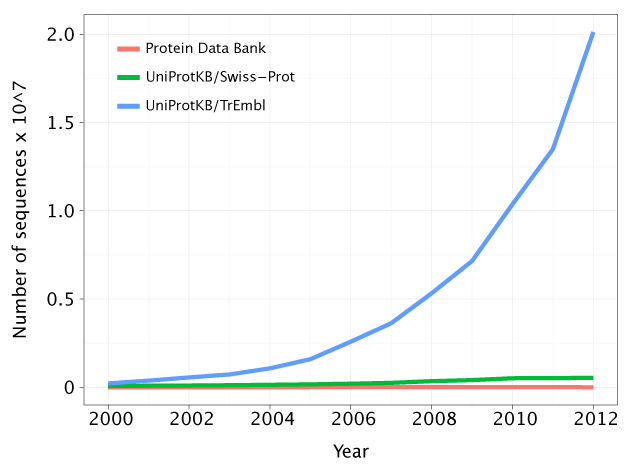
Still, if we look at the number of known genome sequences and known protein structures and at the growth of those figures over the past decade, we look at a drastic scenario:

Growth of Sequences vs Structures


There is a tendency for the gap between the number of protein sequences and protein structures to increase. Hence, we are getting more and more questions and little to no answers. Observe how the green line (the protein sequences associated with a known or predicted function) is very close to the red line (the number of known protein structures). However, there is a growing gap between the red and the blue line (the number of protein sequences). Source: http://gorbi.irb.hr/en/method/growth-of-sequence-databases/

Well, gathering protein structure data is just as important, if not more important, than gathering sequence data. This motivated the creation of Structural Genomics Consortiums (SGC), facilities that specialize in solving protein structures.

I am sorry to tell you that this is all old news. We have known this for years. Nonetheless, the graph above hasn’t changed. Why? The cost limitations and the experimental difficulties associated with protein structure determination are holding us back. Solving protein structures in the lab is hard and time consuming and we are far from being as efficient at structure determination as we are at genome sequencing.

There is a possible solution to the problem: you start with a protein sequence (a sequential aminoacid list) and you try to predict its structure. This is known as protein structure prediction or protein structure modelling. Well, we have a limited number of building blocks (20) and a good understanding of their physicochemical properties, it shouldn’t be that hard right?

Unfortunately, modelling protein structure is not as simple as calculating how fast a block slides on an inclined plane. Predicting protein structure from sequence is a very hard problem indeed! It has troubled a plethora of minds throughout the past decades, making people lose many nights of sleep (I can vouch for that).

We can attribute that to two major limitations:

1- There are so many possible ways one can combine 20 “blocks” in a sequence of hundreds of aminoacids. Each aminoacid can also assume a limited range of conformations. We are looking at a massive combinatorial problem. The conformational space (the space of valid conformations a protein with a given sequence can assume) is so large that if you could check a single conformation every nanosecond, it would still take longer than the age of the universe to probe all possible conformations.

2- Our physics (and our statistics) are inaccurate. We perform so many approximations in order to make the calculations feasible with current computers that we end up with very inaccurate models.

Ok! So now you should know what protein structure prediction is, why it is important and, more importantly, why it is such a hard problem to solve. I am going to finish off by giving you a brief overview of the two most commons approaches to perform protein structure prediction: template-based modelling (also known as homology modelling) and de novo structure prediction.

There is a general understanding that if two proteins have very similar sequences (namely, if they are homologs), than they will have similar structures. So, we can use known structures of homologs as templates to predict other structures. This is known as homology modelling.

One can do a lot of fancy talk to justify why this works. There is the evolutionary argument: “selective pressure acts on the phenotype level (which can encompass a protein structure) rather than the genotype level. Hence protein structures tend to be more conserved than sequence. For that reason and considering that sequence alone is enough to determine structure, similar sequences will have even more similar structures.”

One can also formulate some sort of physics argument: “a similar aminoacid composition will lead to a similar behaviour of the interacting forces that keep the protein structure packed together. Furthermore, the energy minimum where a certain protein structure sits is so stable that it would take quite a lot of changes in the sequence to disturb that minimum energy conformation drastically.”

Probably the best argument in favour of homology modelling is that it works somewhat well. Of course, the accuracy of the models has a strong dependency on the sequence similarity, but for proteins with more than 40% identity, we can use this method in order to obtain good results.

This raises another issue: what if we can’t find a homolog with known structure? How can we model our templateless protein sequence then? Well, turns out that if we group proteins together into families based on their sequence similarity, more than half of the families would not have a member with known structure. [This data was obtained by looking at the representativeness of the Pfam (a protein family database) on the PDB (a protein structure database).]

Ergo, for a majority of cases we have to perform predictions from scratch (known as free modelling or de novo modelling).

Well, not necessarily from scratch. There is a specific approach to free modelling where we can build our models using existing knowledge. We can use chunks of protein, contiguous fragments extracted from known structures, to generate models. This is known as a fragment-based approach to de novo protein structure prediction. And that is one big name!

One can think of this as a small scale homology modelling, where both the physics and evolutionary arguments should still hold true to some degree. And how do we do? Can we generate good models? We perform appallingly! Accuracies are too low to generate any useful knowledge in a majority of cases. The problem with the rare cases when you get it right is that you have no means to know if you actually got the right answer.

The poor quality of the results can be justified by the 2 biggest limitations discussed above. Yet  something else might be in play. In homology modelling, if you use a bad template, you will most certainly get a bad model. In a similar way, using a bad set of fragments will lead you to a very poor final model.

Considering we already have the other two big issues (size of conformational space and accuracy of current potentials) to worry about, we should aim to use the best fragment library we possibly can. This has been the recent focus of my work. An attempt to make a small contribution to solve such a hard problem.

I would love to detail my work on finding better fragments here, but I believe this post is already far too long for anyone to actually endure it and read it until the end. So, congratulations if you made it through!

GPGPUs for bioinformatics

As the clock speed in computer Central Processing Units (CPUs) began to plateau, their data and task parallelism was expanded to compensate. These days (2013) it is not uncommon to find upwards of a dozen processing cores on a single CPU and each core capable of performing 8 calculations as a single operation. Graphics Processing Units were originally intended to assist CPUs by providing hardware optimised to speed up rendering highly parallel graphical data into a frame buffer. As graphical models became more complex, it became difficult to provide a single piece of hardware which implemented an optimised design for every model and every calculation the end user may desire. Instead, GPU designs evolved to be more readily programmable and exhibit greater parallelism. Top-end GPUs are now equipped with over 2,500 simple cores and have their own CUDA or OpenCL programming languages. This new found programmability allowed users the freedom to take non-graphics tasks which would otherwise have saturated a CPU for days and to run them on the highly parallel hardware of the GPU. This technique proved so effective for certain tasks that GPU manufacturers have since begun to tweak their architectures to be suitable not just for graphics processing but also for more general purpose tasks, thus beginning the evolution General Purpose Graphics Processing Unit (GPGPU).

Improvements in data capture and model generation have caused an explosion in the amount of bioinformatic data which is now available. Data which is increasing in volume faster than CPUs are increasing in either speed or parallelism. An example of this can be found here, which displays a graph of the number of proteins stored in the Protein Data Bank per year. To process this vast volume of data, many of the common tools for structure prediction, sequence analysis, molecular dynamics and so forth have now been ported to the GPGPU. The following tools are now GPGPU enabled and offer significant speed-up compared to their CPU-based counterparts:

Application Description Expected Speed Up Multi-GPU Support
Abalone Models molecular dynamics of biopolymers for simulations of proteins, DNA and ligands 4-29x No
ACEMD GPU simulation of molecular mechanics force fields, implicit and explicit solvent 160 ns/day GPU version only Yes
AMBER Suite of programs to simulate molecular dynamics on biomolecule 89.44 ns/day JAC NVE Yes
BarraCUDA Sequence mapping software 6-10x Yes
CUDASW++ Open source software for Smith-Waterman protein database searches on GPUs 10-50x Yes
CUDA-BLASTP Accelerates NCBI BLAST for scanning protein sequence databases 10 Yes
CUSHAW Parallelized short read aligner 10x Yes
DL-POLY Simulate macromolecules, polymers, ionic systems, etc on a distributed memory parallel computer 4x Yes
GPU-BLAST Local search with fast k-tuple heuristic 3-4x No
GROMACS Simulation of biochemical molecules with complicated bond interactions 165 ns/Day DHFR No
GPU-HMMER Parallelized local and global search with profile Hidden Markov models 60-100x Yes
HOOMD-Blue Particle dynamics package written from the ground up for GPUs 2x Yes
LAMMPS Classical molecular dynamics package 3-18x Yes
mCUDA-MEME Ultrafast scalable motif discovery algorithm based on MEME 4-10x Yes
MUMmerGPU An open-source high-throughput parallel pairwise local sequence alignment program 13x No
NAMD Designed for high-performance simulation of large molecular systems 6.44 ns/days STMV 585x 2050s Yes
OpenMM Library and application for molecular dynamics for HPC with GPUs Implicit: 127-213 ns/day; Explicit: 18-55 ns/day DHFR Yes
SeqNFind A commercial GPU Accelerated Sequence Analysis Toolset 400x Yes
TeraChem A general purpose quantum chemistry package 7-50x Yes
UGENE Opensource Smith-Waterman for SSE/CUDA, Suffix array based repeats finder and dotplot 6-8x Yes
WideLM Fits numerous linear models to a fixed design and response 150x Yes

It is important to note however, that due to how GPGPUs handle floating point arithmetic compared to CPUs, results can and will differ between architectures, making a direct comparison impossible. Instead, interval arithmetic may be useful to sanity-check the results generated on the GPU are consistent with those from a CPU based system.

Journal Club: Can Linear Progamming (LP) be useful to us?

Linear programming (LP) is known as a fast and powerful computational technique. It has been applied to a large range of problems in finances and economics, but it is not very popular among us bioinformaticians, computational biologists, and the likes.

Source: http://hotmath.com/hotmath_help/topics/linear-programming.html

Linear Programming is all about find feasible solutions that satisfy a series of constraints (usually represented by inequalities). Does it sound like a familiar problem to bioinformaticians and computational biologists out there?

Source: http://hotmath.com/hotmath_help/topics/linear-programming.html

This leaves room for some questioning: can biological phenomena be modelled or simplified under the assumption of linearity? Furthermore, can LP be used to tackle the many difficult problems posed in our field? Perhaps an even bigger question: why would any of us use Linear Programming instead of another type of linear modelling? What are the advantages of it?

I will not incur in explaining the particulars of LP here. There is a plethora of materials available online (Wikipedia and Wolfram are accessible starting points) that detail Linear Programming. For those eager for something more substantial, V. Chvatal’s Linear Programming and Dantzig’s Linear Programming and Extensions are two good texts on the subject.

During this week’s journal club, I discussed an article that attempted to use Linear Programming to devise knowledge-based Docking Potentials (DP) tailored for transient protein-protein complexes. Transient complexes tend to be under-represented on the PDB, mostly due to the inherent difficulties of crystallizing such complexes. Hence, the development of knowledge-based potentials for these special cases of protein interaction is drastically hindered by a sample size limitation.

Source: Bizzarri AR, Brunori E, Bonanni B, Cannistraro S. Docking and molecular dynamics simulation of the Azurin–Cytochrome c551 electron transfer complex. J. Mol. Recognit. 2007; 20: 122–131

A cartoon representation of a transient complex between Azurin (cyan) and its partner Cytochrome C551 (dark blue) from Pseudomonas aeruginosa. Transient protein complexes are hard to crystallize, hence, under-represented on the PDB.

Source: Bizzarri AR, Brunori E, Bonanni B, Cannistraro S. Docking and molecular dynamics simulation of the Azurin–Cytochrome c551 electron transfer complex. J. Mol. Recognit. 2007; 20: 122–131

To offset such limitation, it would be ideal if one could extrapolate information from decoys (non-native conformations obtained from computational docking tools) in order to improve the Docking potentials. Furthermore, in an ideal world, one would also address the bias introduced by homology/sequence similarity between the existing proteins in the available structures of transient complexes.

The author of the article “Designing coarse grained-and atom based-potentials for protein-protein docking – Tobi D. – BMC Structural Biology 2010, 10:40 doi:10.1186/1472-6807-10-40 ” claims that LP can address such issues by incorporating information from the decoys as linear constraints to the model. The article describes a linear problem, in which the aim is to minimize the variance of how much the non-native energy potentials differ from the native ones. Also, they impose the constraints that native structures must have a lower energy than all of the non-native structures for a given complex (lower in this case is good).

The energy is defined as a weighted sum of the counts of specific interaction types on the complex interface. In their work, the author employed two models: an atom-based model and a side chain-based model. These models are used to classify atoms into groups and to simplify calculations. Initially, they define boolean (one-step) interactions: two atoms interact if they are within a cutoff distance of each other. This cutoff varies according to the type of atoms involved. The initial model led to a state of infeasibility, and it was then replaced by a two-step model, where you have strong and weak interactions and two sets of cutoff (this leads to twice as many unknowns in the LP model).

Well, does it work? How does it fair against other existing knowledge-based DPs?

Source: Designing coarse grained-and atom based-potentials for protein-protein docking. - Tobi D. - BMC Structural Biology 2010, 10:40 doi:10.1186/1472-6807-10-40Source: Designing coarse grained-and atom based-potentials for protein-protein docking. – Tobi D. – BMC Structural Biology 2010, 10:40 doi:10.1186/1472-6807-10-40

Despite the lack of brilliant results or any apparent improvement compared to the state-of-art, the potentials described in the article seem to slightly outperform ZDOCK2.3’s scoring functions.

This may actually speak in favour of the applicability of LP to problems in our area. In the case presented during the journal club, an LP approach produced comparable results to more conventional techniques.

Perhaps the best answer to “why should I use LP?” is that it is an unconventional, creative solution. It is significantly fast and, therefore, easy to try out depending on your problem. Science is all about experimentation, after all. Why would you not try a different technique if you have the means to?

Image Source: http://www.designthenewbusiness.com/blog/documenting/thinking-inside-the-box.html

The moral of the story: it is good to think outside the box, as long as you keep your feet on the ground.

Image Source: http://www.designthenewbusiness.com/blog/documenting/thinking-inside-the-box.html

Check the article discussed in the post here.