16:30 BST 27/06/2023 Oxford, UK. A large number of scientists were spotting riding bicycles across town, to the consternation of onlookers. The event was the Oxford Protein Informatics Group (OPIG) “tour de farce” 2023. A circular bike ride from the Department of Statistics, to The Up in Arms (Marston), The Trout Inn (Godstow), The Perch (Port Meadow) and The Holly Bush (Osney Island). This spurred great bystander-anxiety due to one of a multitude of factors: the impressive size of the jovial horde, the erraticism of the cycling, the deplorable maintenance of certain bikes, and the unchained bizarrerie of the overheard dialogue.
As my turn to write a blog post has fallen a few days after April 1st, I decided I would write an April Fools’ Day-inspired post and ask everyone’s favourite chatbot to tell me some jokes.
I asked ChatGPT to tell me a knock-knock joke, prompting it with various topics relevant to OPIG (including AI, antibodies, drug discovery and proteins) to see what it could come up with. I’d argue that we’re playing fast and loose with the definition of a joke (several of these just made me cringe), but here are some of the results…
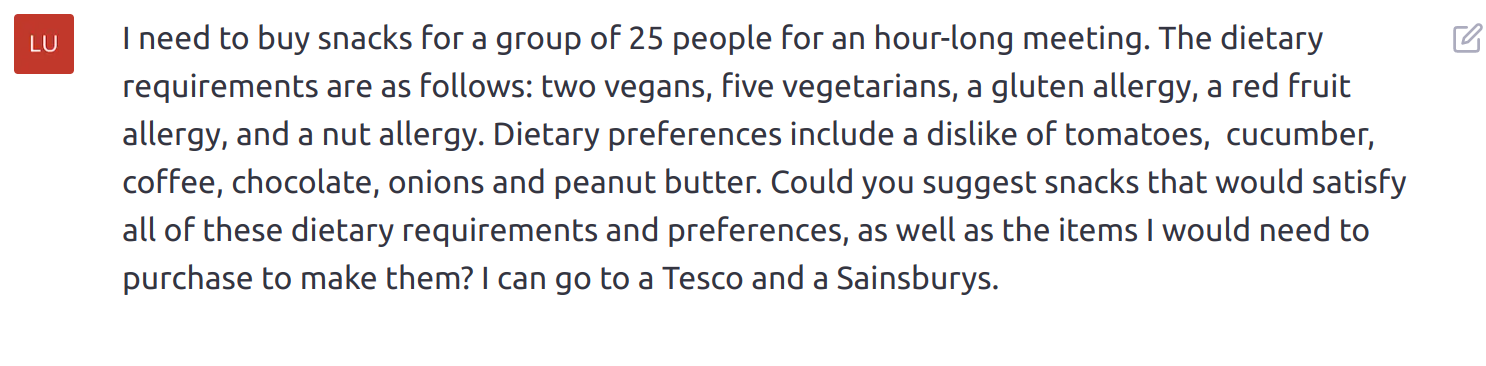
One of the most treasured group meeting institutions in OPIG is snackage. Each week, one group member is asked to bring in treats for our sometimes lengthy 16:30 meeting. However, as would be the case for any group of 25 or so people, there are various dietary requirements and preferences that can make this snack-quisition a somewhat tricky process: from gluten allergies to a mild dislike of cucumber, they vary in importance, but nevertheless are all to be taken into account when the pre-meeting supermarket sweep is carried out.
So, the question on every researcher’s mind: can ChatGPT help me? Turns out, yes: I gave it a list of the group’s dietary requirements and preferences, and it gave me a handy little list of snacks I might be able to bring along…
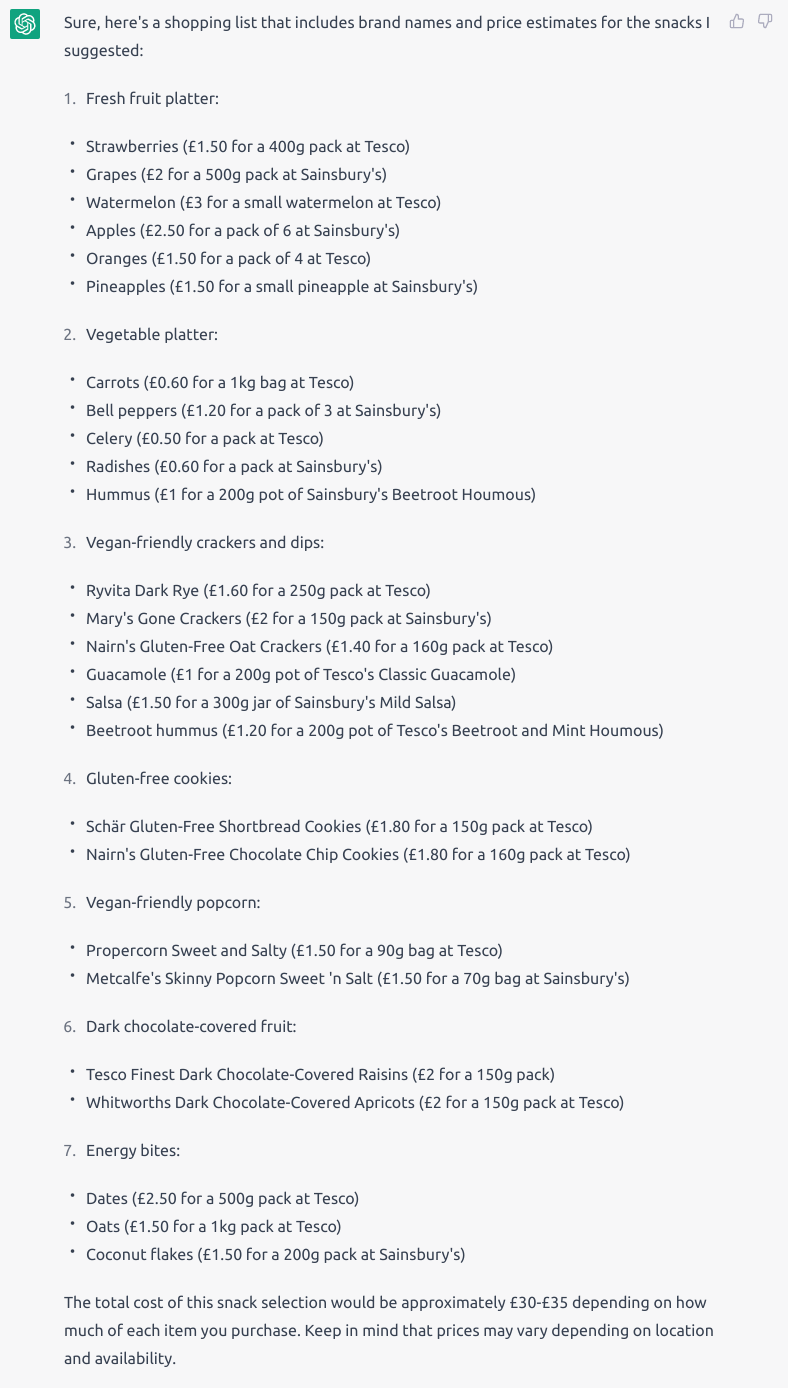
When pushed further, it even provided me with an itemised list of the ingredients required. During this process it seemed to forget a couple of the allergies I’d mentioned earlier, but they were easy to spot; almost more worryingly, it suggested I get a beetroot and mint hummus (!) for the veggie platter:
I don’t know if I’ll actually be using many of these suggestions—judging by the chats I’ve had about the above list, I think bringing in a platter of veggies as the group meeting snack may get me physically removed from the premises—but ChatGPT has once again proven itself a handy tool for saving a few minutes of thinking!
Disclaimer – the title is a Quality Street pun only and bears no relation to the quality of the data or analysis presented below. This whole blog post is basically to discredit the personal chocolate preferences of a group member who shall remain nameless. Safe to say though, they Vostly overestimated people’s love for the Toffee Finger. Long live the Orange Creme.
Nanobodies are an exciting area of increasing interest in the biotherapeutics domain. They consist only of a heavy chain variable domain so are much smaller than conventional antibodies (about 1/10th of their mass) but despite this, manage to achieve comparable affinity for their targets, in addition to being more soluble and stable – good things come in small packages! Nanobodies are not naturally produced in humans but can be derived from camelids (VHHs) or sharks (vNARs) and then engineered to humanise them. For the rest of this blog post we will skip over the science entirely and learn how to draw a llama, a great example of a camelid species.
The languorous, muggy heat of the Korean afternoon sun was what greeted me after 13 hour cattle-class flight from a cool, sensible Helsinki night. The goings-on in Ukraine, and associated political turmoil, meant taking the scenic route – avoiding Russia and instead passing over Turkey, Kazakstan and Mongolia – with legs contorted into unnatural positions and sleep an unattainable dream. Tired and disoriented, I relied less on Anna’s expert knowledge of the Korean language than her patience for my jet-lag-induced bad mood and brain fog. We waited an hour for a bus to take us from Incheon airport to Yongsan central station in the heart of the capital. It was 35 °C.
I’ve been here for a month. Anna has found work, starting in November; I have found the need to modify my working habits. Gone are the comfortable, temperate offices on St Giles’, replaced by an ever-changing diorama of cafés, hotel rooms and libraries. Lugging around my enormous HP Pavilion, known affectionately by some as ‘The Dominator’, proved to be unsustainable.
It’s thesis-writing time for me, so any programming I do is just tinkering and tweaking and fixing the litany of bugs that Lucy Vost has so diligently exposed. I had planned to run Ubuntu on Parallels using my MacBook Air; I discovered to my dismay that a multitude of Conda packages, including PyTorch, are not supported on Apple’s M1 chip. It has been replaced by a combination of Anna’s old Intel MacBook Pro and rewriting my codebase to install and run without a GPU – adversity is the great innovator, as the saying goes.
Brain teasers have a strange power. For many they evoke nothing more than a mild and transient sense of curiosity. But for a certain subset of people they create an irresistible intellectual temptation which even needs to actively be avoided at times as not to completely derail conversations and take over whole afternoons.
For better or worse, I am in the camp of people who are highly susceptible to brain teasers. I just love them too much. More than once in my lifetime I had to ask a friend not to tell me about a particular brain teaser they had heard about because I knew it would inevitably take over my mind and send me down an almost hypnotic spiral of thoughts whose only escape would be finding the solution.
While brain teasers can admittedly turn into ridiculously powerful distractions for some of us, they are not necessarily a waste of time. They have high recreational value and help the mind to enter a playful and creative state. They serve as mental gymnastics to directly train logical thinking skills, and logical thinking is arguably one of the most powerful transferable skills that exists. And last but not least, brain teasers are canonically used nowadays in job interviews at some of the worlds top employers (Google, Facebook, Microsoft, prestigious hedge funds, …).
In this post, I will present one of my favourite brain teasers to see if I can get you hooked. It is a slightly modified and self-contained version of the so-called pirate game. You can find the solution at the end of the page. Enjoy responsibly!
Continue reading →
Picture this: You’re a zealous acolyte of the metric system, with a rare affliction that makes multiplying decimal numbers impossible. You’re on holiday in the UK, where road signs give distances in miles. Heathens! How can you efficiently estimate the number of kilometres without multiplying by approximately 1.60934?
Websites store cookies to enhance functionality and personalise your experience. You can manage your preferences, but blocking some cookies may impact site performance and services.
Essential cookies enable basic functions and are necessary for the proper function of the website.
Name
Description
Duration
Cookie Preferences
This cookie is used to store the user's cookie consent preferences.
30 days
These cookies are used for managing login functionality on this website.
Name
Description
Duration
wordpress_logged_in
Used to store logged-in users.
Persistent
wordpress_sec
Used to track the user across multiple sessions.
15 days
wordpress_test_cookie
Used to determine if cookies are enabled.
Session
Statistics cookies collect information anonymously. This information helps us understand how visitors use our website.
Google Analytics is a powerful tool that tracks and analyzes website traffic for informed marketing decisions.
Contains information related to marketing campaigns of the user. These are shared with Google AdWords / Google Ads when the Google Ads and Google Analytics accounts are linked together.
90 days
__utma
ID used to identify users and sessions
2 years after last activity
__utmt
Used to monitor number of Google Analytics server requests
10 minutes
__utmb
Used to distinguish new sessions and visits. This cookie is set when the GA.js javascript library is loaded and there is no existing __utmb cookie. The cookie is updated every time data is sent to the Google Analytics server.
30 minutes after last activity
__utmc
Used only with old Urchin versions of Google Analytics and not with GA.js. Was used to distinguish between new sessions and visits at the end of a session.
End of session (browser)
__utmz
Contains information about the traffic source or campaign that directed user to the website. The cookie is set when the GA.js javascript is loaded and updated when data is sent to the Google Anaytics server
6 months after last activity
__utmv
Contains custom information set by the web developer via the _setCustomVar method in Google Analytics. This cookie is updated every time new data is sent to the Google Analytics server.
2 years after last activity
__utmx
Used to determine whether a user is included in an A / B or Multivariate test.
18 months
_ga
ID used to identify users
2 years
_gali
Used by Google Analytics to determine which links on a page are being clicked
30 seconds
_ga_
ID used to identify users
2 years
_gid
ID used to identify users for 24 hours after last activity
24 hours
_gat
Used to monitor number of Google Analytics server requests when using Google Tag Manager
1 minute
Google reCAPTCHA helps protect websites from spam and abuse by verifying user interactions through challenges.
Name
Description
Duration
_GRECAPTCHA
Google reCAPTCHA sets a necessary cookie (_GRECAPTCHA) when executed for the purpose of providing its risk analysis.